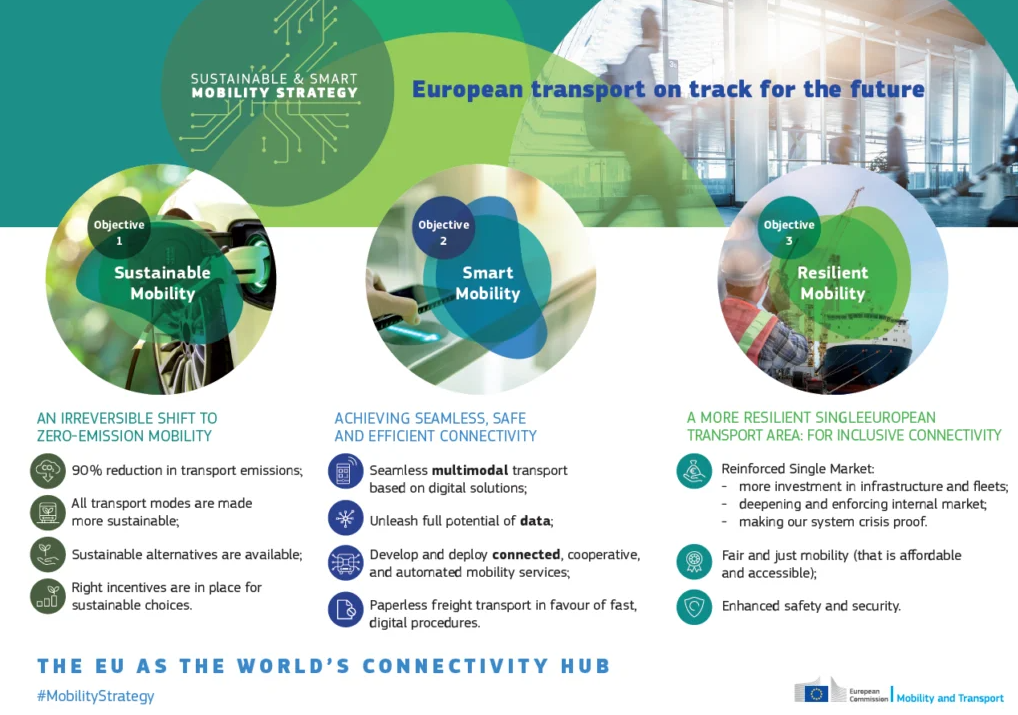
European promotion of active travel - Sustainable Smart Mobility strategy
Integrated Transport
Mobility as a service
Cycling
The European Union (EU) adopted a Sustainable and Smart Mobility Strategy, which aims to transform the EU transport system and align it with the European Green Deal, by making it green, digital and resilient. The strategy sets out a vision for a 90% reduction in transport-related greenhouse gas emissions by 2050, as well as a number of milestones and actions to achieve this goal.
One of the key areas of action in the strategy is to boost the uptake of zero-emission vehicles and alternative fuels, as well as to improve the efficiency and connectivity of the transport system. However, the strategy also recognises the importance of promoting mobility and active travel, such as walking, cycling and public transport, as a way to reduce emissions, improve health and quality of life, and create more liveable and accessible urban areas.
According to the strategy, mobility and active travel should be supported by several measures, such as:
- Developing a comprehensive network of safe and secure infrastructure for walking and cycling across the EU, as part of the Trans-European Transport Network (TEN-T), which connects major transport hubs and corridors in Europe.
- Implementing the EU Cycling Strategy, which proposes actions to increase cycling levels by 50% by 2030, such as setting common standards for bike-sharing schemes, integrating cycling into multimodal transport planning, and promoting cycling tourism.
- Promoting the use of public transport, especially in urban areas, by increasing its accessibility, affordability, reliability and safety, as well as by supporting the deployment of clean and low-emission buses, trams and trains.
- Encouraging a shift from private car use to more sustainable modes of transport, such as car-sharing, car-pooling and ride-hailing services, by creating a level playing field for these services, ensuring fair taxation and regulation, and fostering interoperability and data sharing.
- Supporting the development of mobility-as-a-service (MaaS) platforms, which offer integrated and personalised travel options across different modes of transport, by facilitating data access and exchange, ensuring consumer protection and privacy, and creating common standards and rules.
- Enhancing urban mobility planning and governance, by providing guidance, funding and technical assistance to local authorities, as well as by fostering cooperation and coordination among different levels of government and stakeholders.
The strategy is expected to significantly impact the EU transport system and its contribution to climate action. However, it also faces some challenges and uncertainties, such as:
- The need for sufficient funding and investment to support the transition to sustainable and smart mobility
- The need for coordination and cooperation among different actors at the EU, national, regional and local levels
- The need for social acceptance and behavioural change among transport users
- The need for innovation and adaptation to new technologies and business models
- The need for monitoring and evaluation of the progress and impact of the strategy
Sources:
from https://transport.ec.europa.eu/transport-themes/mobility-strategy_en
https://www.europarl.europa.eu/RegData/etudes/BRIE/2021/659455/EPRS_BRI(2021)659455_EN.pdf
https://transport.ec.europa.eu/system/files/2020-12/mobility-strategy-memo-qa.pdf
https://www.electrive.com/2020/12/10/eu-reveals-sustainable-and-smart-mobility-strategy/
https://www.electrive.com/2020/12/10/eu-reveals-sustainable-and-smart-mobility-strategy/