Mobility in Rural Ireland: Challenges and Opportunities
Integrated Transport
Accessibility
Planning
Mobility is a key factor for the quality of life and economic development of rural areas, as it enables access to services, employment, education, social and cultural activities, and markets. However, rural Ireland faces several challenges in terms of mobility, such as low population density, dispersed settlement patterns, ageing population, limited public transport options, high dependency on private cars, and environmental impacts. This article explores these challenges and the potential opportunities for enhancing mobility and accessibility in rural areas, in the context of the Project Our Rural Future: Rural Development Policy 2021-2025.
The Project Our Rural Future: Rural Development Policy 2021-2025 is the new whole-of-Government policy for the sustainable development of rural Ireland, which was launched on 29 March 2021. It sets out a long-term vision for a vibrant and sustainable rural Ireland, and provides a framework for the recovery and development of rural areas over the next 5 years. It aims to improve mobility and accessibility in rural areas by supporting a range of measures and initiatives, such as:
- Developing a rural mobility plan to coordinate and integrate transport services and infrastructure across rural areas.
- Expanding the Local Link rural transport service to provide more frequent, reliable and demand-responsive services.
- Promoting active travel modes such as walking and cycling, by investing in greenways, blueways, cycle paths and trails.
- Supporting the transition to low-carbon and electric vehicles, by increasing the number of charging points and incentivising their use.
- Enhancing digital connectivity to enable remote working, online learning, e-health and e-government services, and reduce the need for travel.
The policy also recognises the importance of engaging with rural communities, stakeholders and service providers to ensure that the mobility needs and preferences of rural residents are met.
Key data and/or key info:
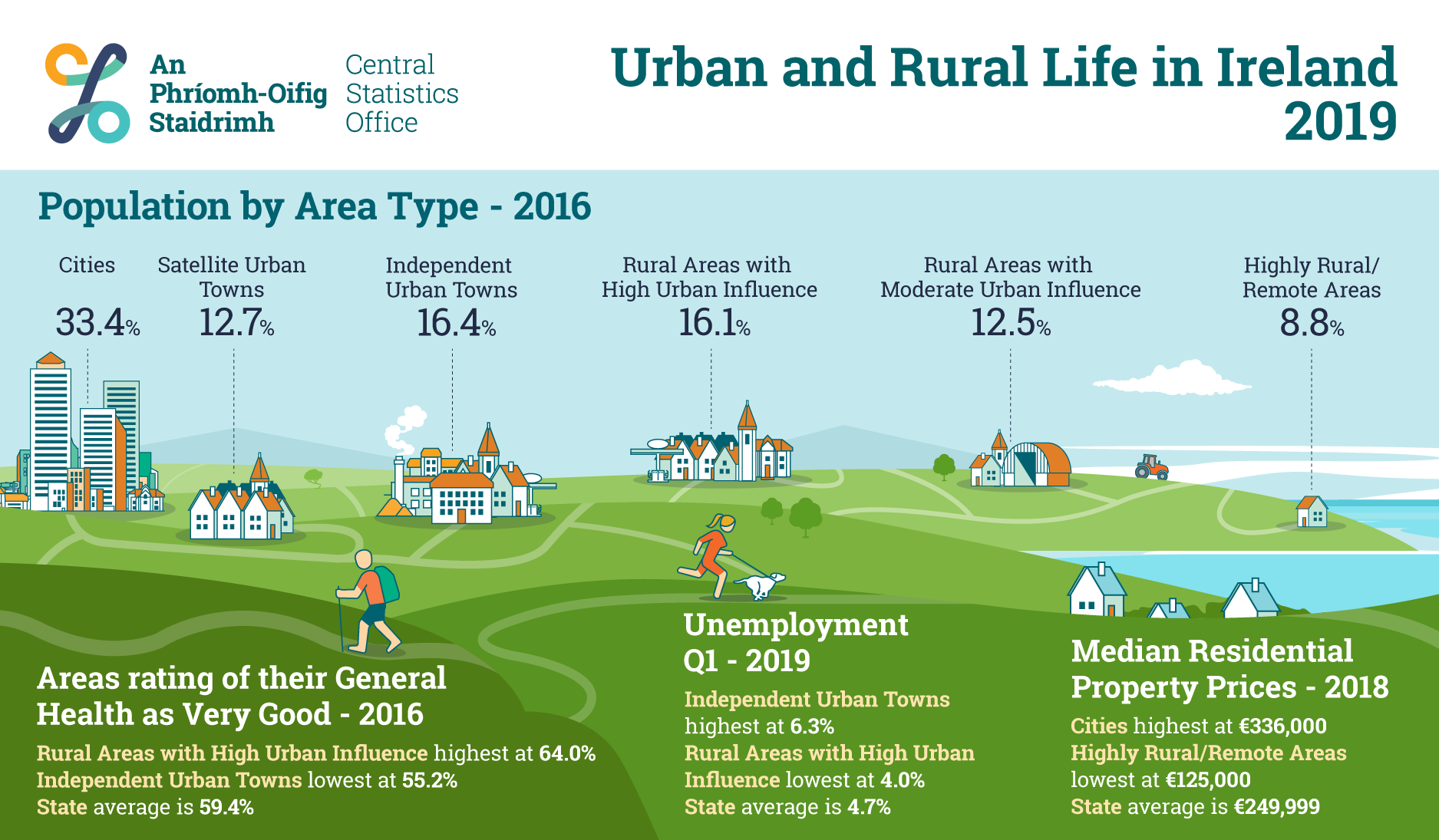
- According to the 2016 Census, 37% of Ireland's population (or 1.75 million people) live in rural areas, defined as areas outside towns of 1,500 or more inhabitants.
- Rural dwellers travel on average 50% more kilometres per day than urban dwellers, and spend more time travelling.
- In 2016, 82% of rural households had access to at least one car, compared to 65% of urban households.
- In 2019, only 4.4% of rural workers used public transport to commute to work, compared to 25.8% of urban workers.
- In 2020, Ireland had about 17,000 electric vehicles (EVs) on the road, and about 1,100 public charging points.
Sources:
https://www.cso.ie/en/releasesandpublications/ep/p-cp8iter/p8iter/p8rrc/
https://www.cso.ie/en/releasesandpublications/ep/p-nhts/nhts2016/2016nhts/
https://www.cso.ie/en/releasesandpublications/er/cpamr/commutinginireland2019/
https://www.seai.ie/publications/Electric-Vehicle-Report-2020.pdf