National Sustainable Mobility Policy: Summary
Safety & Security
Integrated Transport
Accessibility
Behavioural Change
Purpose & Target
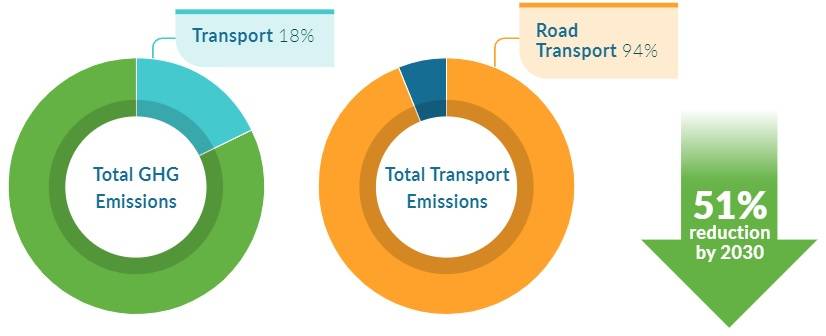
The National Sustainable Mobility Policy sets out a strategic framework to 2030 for active travel (walking and cycling) and public transport journeys to help Ireland meet its climate obligations to achieve a 51% reduction in carbon emissions by the end of this decade. It is accompanied by an action plan to 2025 which contains actions to improve and expand sustainable mobility options across the country by providing safe, green, accessible and efficient alternatives to car journeys. It also includes demand management and behavioural change measures to manage daily travel demand more efficiently and to reduce the journeys taken by private car.
The policy aims to deliver at least 500,000 additional daily active travel and public transport journeys by 2030 and a 10% reduction in the number of kilometres driven by fossil fuelled cars. It will make it easier for people to choose walking, cycling and use public transport daily instead of having to use a petrol or diesel car.
Principles, goals and actions
The Policy is guided by three key principles which are underpinned by 10 high-level goals.
Principle I: Safe and Green Mobility
Goals:
1. Improve mobility safety.
2. Decarbonise public transport.
3. Expand availability of sustainable mobility in metropolitan areas.
4. Expand availability of sustainable mobility in regional and rural areas.
5. Encourage people to choose sustainable mobility over private car.
Actions:
- Continuing to protect and maintain the safety of existing walking, cycling and public transport networks and ensuring that new sustainable mobility infrastructure meets the highest safety standards.
- Continuing measures to address safety issues when travelling on public transport.
- Developing pedestrian enhancement plans and cycle network plans to guide investment in new active travel infrastructure and retrofitting of existing infrastructure.
- Expanding walking and cycling options across the country, including greenways.
- Rolling out the Safe Routes to School Programme.
- Transitioning the public transport fleets to low and zero emission vehicles.
- Expanding bus capacity and services through the BusConnects Programmes in the five cities of Cork, Dublin, Galway, Limerick and Waterford; improved town bus services; and the Connecting Ireland programme in rural areas.
- Developing an enhanced bus stop programme for regional and rural services Improving rail infrastructure in the five cities.
- Improving journey times and reliability on the inter-urban and regional rail network.
- Expanding electrification of the rail network in the Greater Dublin Area under the DART+ programme.
- Commencing construction of MetroLink in Dublin.
- Continuing the design and development of other light rail projects in the Greater Dublin Area and Cork, and considering the feasibility of light rail in Galway.
- Rebalancing transport movement in metropolitan areas and other urban centres away from the private car and towards active travel and public transport. Identifying a pathway for the implementation of suitable demand management measures at national and local level to reduce reliance on the private car.
- Expanding behavioural change measures including the Smarter Travel Workplaces and Campus Programmes and Cycle Right training programme.
Principle II: People Focused Mobility
Goals:
6. Take a whole of journey approach to mobility, promoting inclusive access for all.
7. Design infrastructure according to Universal Design Principles and the Hierarchy of Road Users model.
8. Promote sustainable mobility through research and citizen engagement.
Actions:
- Continuing to make existing and new walking, cycling and public transport networks more accessible for all users.
- Implementing a universal design approach in the design of walking, cycling and public transport infrastructure and in the retrofitting of older infrastructure.
- Introducing a more equitable fares structure.
- Reviewing, updating and developing existing guidelines, standards and supporting legislation, where necessary, to allow for a range of solutions to be developed for the reallocation of road space use to prioritise walking, cycling and public transport.
Principle III: Better Integrated Mobility
Goals:
9. Better integrate land use and transport planning at all levels.
10. Promote smart and integrated mobility through innovative technologies and development of appropriate regulation.
Actions:
- Adopting a transport-orientated housing development approach.
- Identifying housing delivery areas within a 1 km distance of public transport stops with the best potential to grow.
- Delivering metropolitan area transport strategies in the five cities and preparing local transport plans for the regional growth centres and key towns.
- Expanding the transport planning remit of the National Transport Authority (NTA) to all of the five cities.
- Developing a governance framework for Mobility as a Service (MaaS).
Delivery of sustainable Mobility
The Policy aims to improve the Delivery of Sustainable Mobility by:
- Implementing the accompanying action plan to 2025 and a reviewed and updated action plan for 2026 to 2030.
- Establishing a Leadership Group to oversee and drive implementation of the Policy and delivery of the action plan, and agree a programme of “pathfinder” projects at local level.
- Introducing a new annual National Household Travel Survey to measure progress against the Policy’s targets.
- Convening a new National Sustainable Mobility Forum to provide a platform for collaborative engagement with national, regional and local stakeholders.
- Increasing public engagement around the benefits of sustainable mobility and raising awareness of the availability of alternative options to the private car.
- Establishing a new National Transport Authority Advisory Council to engage with the NTA around the discharge of its functions.
- Developing a transport research network to support existing research programmes and draw on the sustainable mobility expertise available across academia and industry, both in Ireland and internationally.
Source: National Sustainable Mobility Policy - Department of Transport