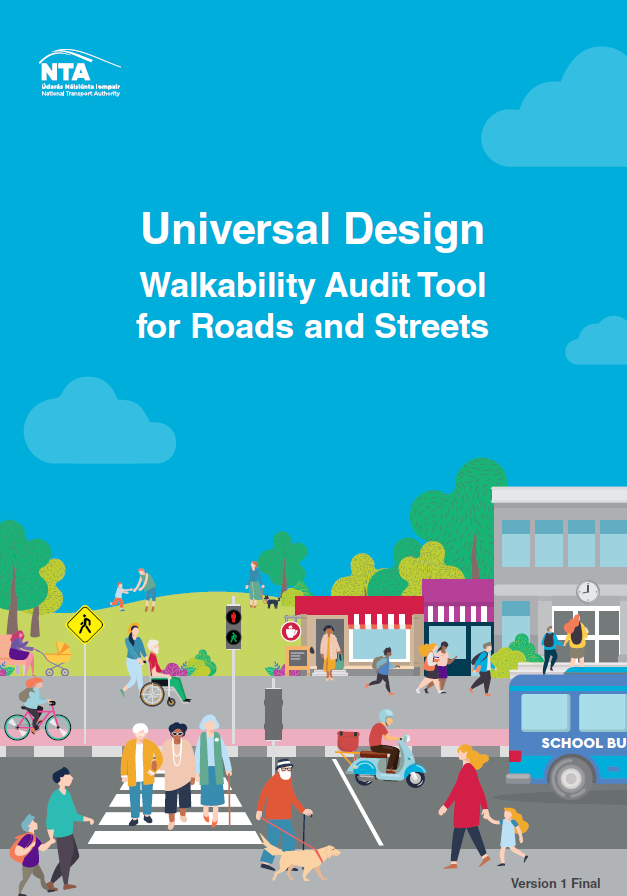
Universal Design Walkability Audit Tool for Roads and Streets
Walking
Accessibility
Design
The Universal Design Walkability Audit Tool for Roads and Streets is a practical assessment framework developed to evaluate how accessible, safe and inclusive a walking route or street environment is for people of all ages and abilities. It was created collaboratively by the National Transport Authority (NTA), Age Friendly Ireland, Green-Schools, and the National Disability Authority’s Centre for Excellence in Universal Design (CEUD).
The tool is designed to capture the existing conditions of a selected walking route, assessing its overall walkability, which refers to how friendly an area is for people walking, living, shopping, visiting, engaging or simply spending time in the space. Common features assessed include footpath quality, continuity, surface condition, crossing safety, lighting, seating, signage, and overall comfort. The aim is to identify barriers, highlight positive aspects, and ultimately generate a priority list of recommendations for improvements that can inform Local Authority planning for roads, streets, and public spaces.
A key strength of the tool is its Universal Design approach, which encourages involvement from a diverse group of participants such as older people, school children, parents with buggies, wheelchair users, people with visual impairments, community organisations, Local Authority officers, and school travel planners. This ensures that the audit reflects the real experiences of people with different mobility, sensory, and cognitive needs. Audits are usually carried out by groups supported by trained coordinators from Age Friendly Ireland or Green-Schools Travel, although they can also be conducted independently by individuals.
A typical audit covers a walking route of 20–30 minutes, with the full process — including briefing, walk-through, and debriefing — taking around 45 minutes or more, depending on the group. Participants document conditions along the route, discuss findings, and contribute to the final summary that highlights issues and potential improvements.
The development of the tool was informed by earlier walkability work, including pilot audits such as the Kilrush, Co. Clare study conducted in partnership with Age Friendly Ireland using a draft version of the tool. This earlier work helped shape the criteria and structure of the final published tool. The tool also builds on Age Friendly Ireland’s broader series of walkability audits carried out since 2013, which examined accessibility around towns and public buildings. These findings have contributed to creating environments that support healthier, safer, and more socially inclusive communities.
Overall, the Universal Design Walkability Audit Tool is a low-cost, practical and inclusive method for communities and local authorities to identify ways to improve accessibility and ensure that public streets and spaces can be used safely, conveniently, and independently by everyone. It supports improved planning, enhances Age Friendly environments, and strengthens community engagement in shaping local infrastructure